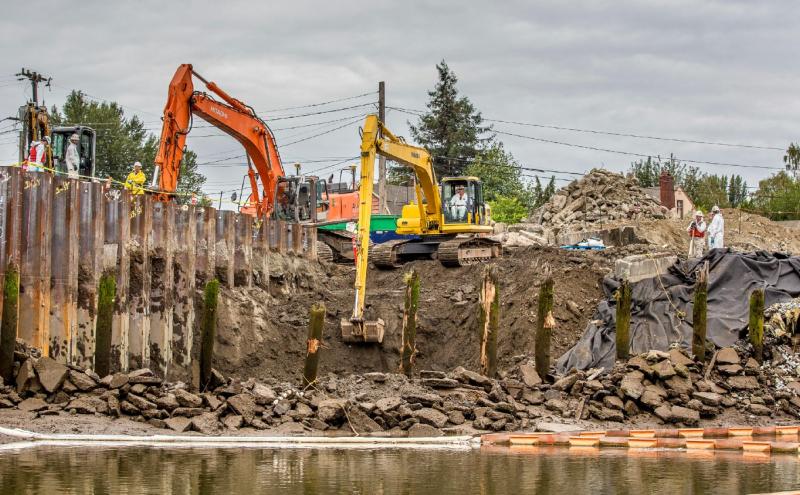
Learn more about the Port's active cleanup projects below. Contact information for each project is provided.
Learn more about the Port's active cleanup projects below. Contact information for each project is provided.
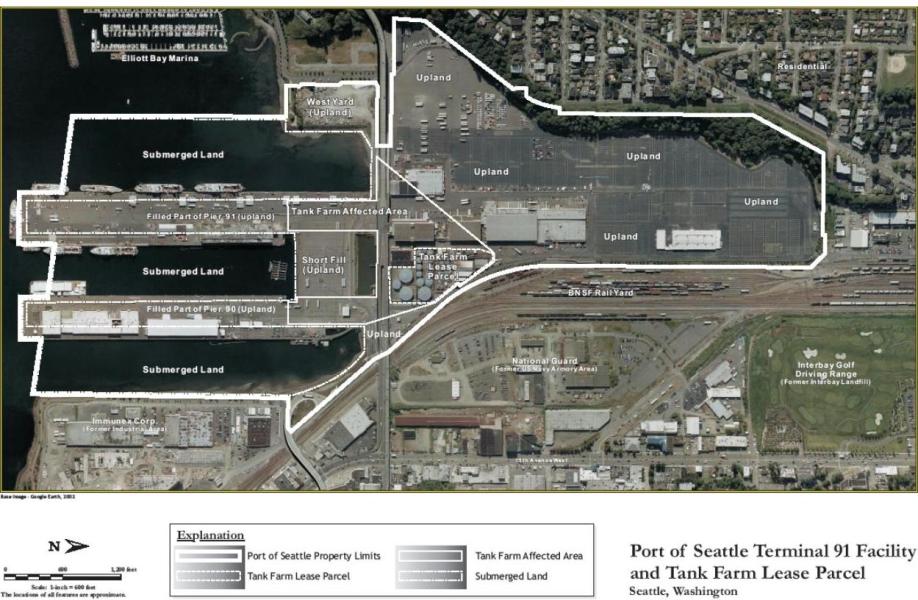
Terminal 91 (T-91) is a 210-acre site located at 2001 West Garfield Street in the Interbay neighborhood of Seattle, Washington. The property consists of an upland area, two piers (Piers 90 and 91), and submerged sediment around the piers. The site is currently used as a cruise ship terminal, and for tug and large vessel moorage, commercial fishing vessel offloading and moorage, and seafood cold storage. There is also a business complex with various storage areas.
The Great Northern Railroad began to develop the area in the late 1890s by filling the area between Magnolia and Queen Anne. In 1913, the Port purchased property from the Great Northern Railroad to create T-91. Pier 90 was constructed in 1913, and Pier 91 was constructed in 1919; they were designated as Piers 40 and 41, respectively, and were the largest earth-filled commercial piers in the world at that time. Piers 90 and 91 were originally used for loading and unloading materials such as lumber, steel, and coal and for storing vegetable oil. The Port operated T-91 from 1913 to 1942.
From 1942 to 1976, the United States Navy took over T-91 as a naval station and expanded the boundaries to include all the property that is there today. The Navy sold the property back to the Port in 1976.
In addition to the Piers, a 4-acre tank farm was constructed in the 1920s and leased by the Port to various tenants for fuel storage until the Navy took over the tank farm as a fuel and lubricating oil transfer station. From the late 1970s until 1995, the tank farm served as a waste oil recovery and wastewater treatment and storage facility. It was demolished in 2005 after being used for fuel storage and blending from 1995 to 2003.
Historical activities at T-91 contaminated the sediment, soil and groundwater with gasoline and heavy oil range petroleum, metals, phthalates, semi-volatile organic compounds, polyaromatic hydrocarbons, polychlorinated biphenyls. Discarded military munitions were also discovered in the sediment at T-91 in 2010.
As the current property owner, the Port is leading the effort to address contamination at the site. The entire T-91 facility is regulated by the Department of Ecology (Ecology) under a Dangerous Waste Management Permit. This includes corrective action requirements under the federal Resource Conservation and Recovery Act to address contamination at a hazardous waste treatment, storage and disposal facilities. The Port has conducted several site investigations and cleanups under these requirements.
The upland cleanup of soil and groundwater has been completed, and the groundwater continues to be monitored to confirm that cleanup goals are being met.
The sediment remedial investigation was completed in December 2023. A sediment feasibility study is underway and will be completed in 2027. Ecology is expected to issue a Cleanup Plan by the end of 2027, following a public comment period. The Cleanup design will be conducted in 2028, with cleanup itself beginning in 2029 or 2030.
Upland: Jalyn Buckley | Environmental Management Specialist | [email protected]
Sediment: Joy Dunay | Senior Environmental Program Manger | [email protected]
Visit Ecology’s Terminal 91 Cleanup Site page for more information.
Terminal 25 (T-25) South is on the southeast bank of the East Waterway at 2917 East Marginal Way South in Seattle, Washington. T-25 South includes approximately 5 acres of upland area and 5 acres of submerged and intertidal areas. The in-water portion of the site contains a derelict pier structure with creosote pilings. On behalf of the Port, the Northwest Seaport Alliance currently leases portions of the upland T-25 South to various tenants who use the area for equipment and material laydown, light industrial activity, and truck parking.
Prior to the channelization of the Duwamish River in the 1900s, the land occupied by present-day T-25, was part of the Elliott Bay tide flats. During channelization, the flats were filled with various materials including dredged soils. The Port acquired the site in 1913. The site was used for cold storage, logging facilities, and as a sawmill during the early 20th century. The sawmill was removed to allow for lumber storage and automobile staging in the early 1960s. During the 1980s, it was used for cold storage, seafood processing, and shipping operations. Most structures and buildings at the site were demolished in the 1990s.
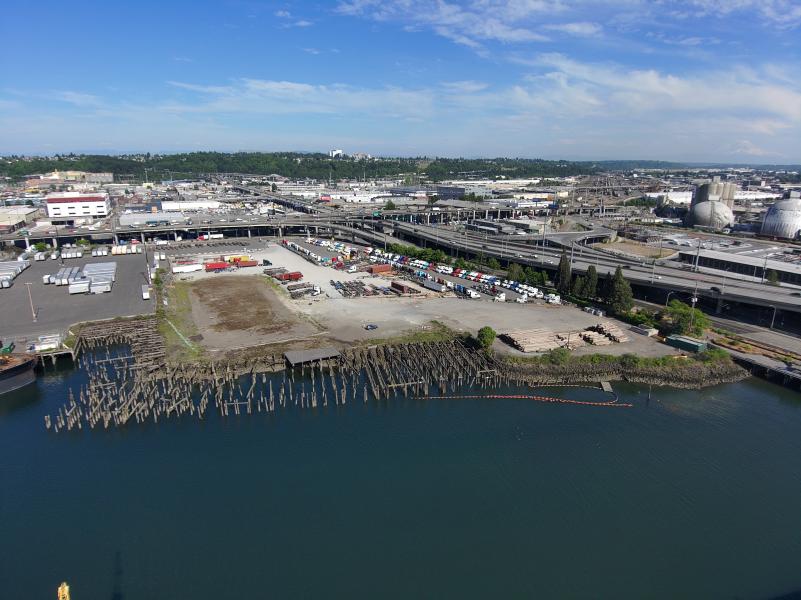
(Existing conditions at Terminal 25 South site.)
Historical activities contaminated the sediment and soil at the site. The primary contaminants of concern are polychlorinated biphenyls, dioxin and furans, and petroleum.
As the property owner, the Port is leading the effort to address contamination at the site. The cleanup will be designed to protect human health and the environment at the Site, as well as to prevent recontamination of the adjacent East Waterway.
Following the cleanup, the Port plans to construct critical fish and wildlife habitat to support recovery of the endangered Southern Resident orca. The restoration will significantly increase habitat critical for Chinook salmon, the primary food source for the orcas. The goal is to restore estuarine wetland functions across the site as well as to restore and create riparian habitat and off-channel rearing and refuge habitat for salmonids and other migratory and resident fish and wildlife in the East Waterway. The project will ultimately re-establish approximately 10 acres of riparian, emergent marsh, mudflat, and subtidal habitat.
The site is currently in the process of being cleaned up under the oversight of the United States Environmental Protection Agency (EPA). The sediment, soil, and ground water investigation were completed in 2024. An engineering evaluation/cost analysis was submitted to the EPA in the winter 2025. The Port anticipates receiving the EPA’s cleanup approval in mid-2026 following a public comment period.
Joy Dunay | Senior Environmental Program Manager | [email protected]
Terminal 108 (T-108) is located along East Marginal Way on the east shore of the Lower Duwamish Waterway (LDW) on approximately 20 acres of property at 4525 Diagonal Avenue South, Seattle, Washington. T-108 consists of two parcels owned and managed by the Port: the West Parcel (nine acres) and the East Parcel (11 acres). The East Parcel is leased to a tenant for container storage, repair, and chassis storage. The West Parcel is not currently occupied by a tenant but is used for material storage. A Port public access and habitat mitigation area (sbəq̓ʷaʔ Park and Shoreline Habitat) is located along the southern shoreline of the West Parcel, adjacent to the LDW.
Prior to the channelization of the Duwamish River in the early 1900s the Site was an undeveloped tidal marsh. Beginning in 1938, T-108 was the historical location of one of the City of Seattle’s (City) first wastewater treatment plants, serving the residential and industrial areas of several south Seattle neighborhoods including SoDo, Beacon Hill and Georgetown. The plant closed in 1970, and structures were demolished soon after; however, several acres of sewage sludge was left as fill across much of the site.
IIn 1972 the City sold the property to Chiyoda Corporation International for construction of a chemical manufacturing plant. Chiyoda’s manufacturing plant was never constructed; however, Chiyoda did complete site preparation work including dredging along the shoreline and removal of previously abandoned sewage treatment plant structures. From 1974 to 1977, Chiyoda leased the property to the federal government to store and treat approximately 10 million gallons of hydraulically dredged sediment slurry associated with the federal government’s cleanup of its 1974 polychlorinated biphenyl (PCB) transformer fluid spill in the LDW.
The Port acquired the property from Chiyoda in 1984 and divided the property into two parcels in 1985. Chevron purchased the East Parcel from the Port in 1985 with plans to construct a petroleum distribution terminal. Chevron’s terminal was never constructed; however, Chevron did use the property to stockpile and land farm petroleum-contaminated soil. Chevron owned the East Parcel until 1992, when it was conveyed back to the Port.
The Port leased the West Parcel to Lafarge Cement Company for use as a bulk cement distribution terminal from 1989 to 1998. In 1996, the Port redeveloped the entire east parcel of the property into its current layout and use as a container storage yard.
Historical activities led to the contamination of the site’s soil and groundwater. The primary contaminants of concern are PCBs, heavy metals, and petroleum.
As the current property owner, the Port is leading efforts to address contamination at the site along with the City of Seattle. This cleanup is being conducted under an Administrative Settlement Agreement and Order on Consent between the U.S. EPA and the Port, City of Seattle, and King County. The cleanup will be designed to protect human health and the environment at the Site, as well as to prevent recontamination of the adjacent LDW.
The Engineering Evaluation and Cost Analysis (EE/CA) investigation was completed in 2024. We are currently working on the EE/CA report and expect to have that completed by the end 2026 or early 2027.
Roy Kuroiwa | Environmental Program Manager | [email protected]
Visit the Terminal 108 project page for more information.
Terminal 30 (T-30) is a 33.9-acre property addressed at 1901 East Marginal Way South in Seattle, Washington. The site is located on the eastern shoreline of the East Waterway. The cleanup site is comprised of one large and one small area totaling approximately 11 acres located in the northern portion of the property. T-30 currently operates as a freight terminal and provides shipping container storage. T-30 is currently vacant, but provides temporary cargo storage, as needed.
Prior to the channelization of the Duwamish River in the 1900s, the land occupied by present-day T-30 was part of the Elliot Bay tide flats. During channelization, the flats were filled with various materials including dredged materials. In 1905, the Standard Oil Company (now Chevron) occupied the northern portion of the site and operated a bulk fuel terminal where fuels including gasoline, diesel, and heating oil were stored in numerous above-ground tanks. The southern portion of the terminal was used for a variety of industrial operations, including a lumber yard, a machine shop, and a shipyard. In 1950, Chevron expanded the fuel terminal to the southern portion of the site. In 1985, the Port purchased the site from Chevron and redeveloped it as a cargo container terminal. From 2003 to 2008 the site included a cruise ship terminal.
Historical operations contaminated soil and groundwater. The soil is contaminated with petroleum. Groundwater contaminants include petroleum, benzene, and polyaromatic hydrocarbons. An on-site stormwater management system treats stormwater runoff using oil and water separators and filters before discharging the water into the East Waterway. Contaminated groundwater does not enter the on-site stormwater system or the East Waterway.
In the 1980s, Chevron discovered petroleum contamination in the soil and groundwater and initiated the cleanup work. The Port purchased the property in 1985 and continues cleanup efforts at T-30 to ensure the protection of human health and prevent contamination discharging into the East Waterway, which is an active Superfund site.
The cleanup is being conducted under an Agreed Order (AO) between Washington State Department of Ecology (Ecology) and the Port. The AO requires the Port to implement the remedial actions set forth in the Cleanup Action Plan, including confirmation, performance, and compliance monitoring. The Port currently performs quarterly air sparging and soil vapor extraction treatment and light non-aqueous phase liquid (LNAPL) recovery.
The site is currently in the long-term operation and maintenance phase of the cleanup. The Port operates the onsite air sparge/soil vapor extraction system and performs vapor monitoring twice per month, as well as monthly LNAPL gauging and quarterly LNAPL recovery. Groundwater monitoring is performed on a semiannual basis.
Jalyn Buckley | Environmental Management Specialist | [email protected]
Visit Ecology’s Terminal 30 Cleanup Site page for more information.
Terminal 115 Plant 1 site (T-115) is in the industrial area along the western shore of the Lower Duwamish Waterway (LDW) at 6000 West Marginal Way SW, Seattle, Washington. T-115 comprises approximately 94 acres over two parcels owned by the Port. The property is leased by tenants who perform seafood processing, storage, and shipping; marine cargo shipping; and commercial vehicle fueling.
Historical industrial and commercial operations at the terminal began in the early 1900s. These activities included airplane production at the Former Boeing Plant 1 from 1917 to 1970; several historical and existing gas and service stations; releases from former underground storage tanks; gravel, concrete, and cement production; car wash operations; and extensive filling of historically submerged land.
Over the past century, the LDW shoreline was reshaped and realigned to better fit the needs of industrial tenants and maritime navigation. Sediment from these realignment projects was used to fill low spots and smaller channels at T-115, increasing the overall footprint and elevation of the terminal. The Port purchased the property in approximately 1970.
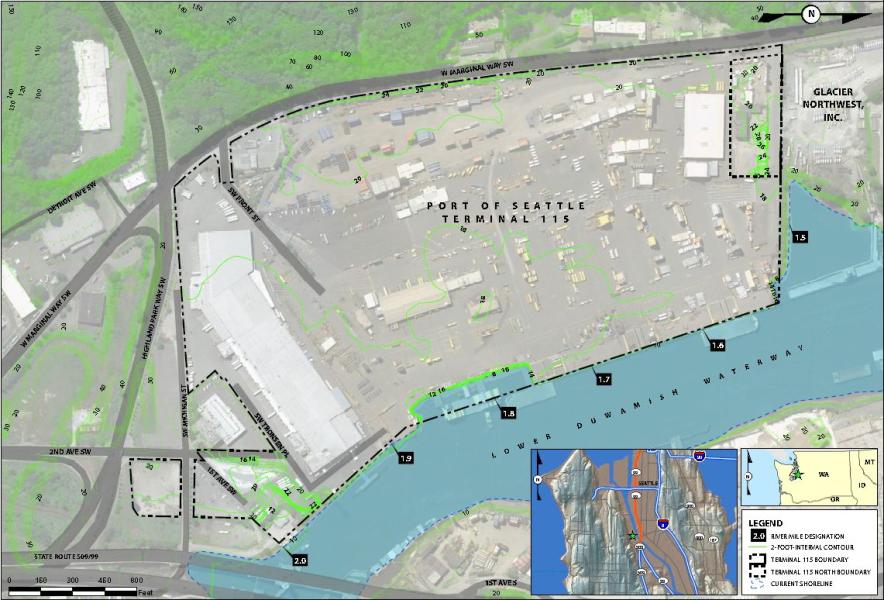
Past operations led to soil and groundwater contamination. Chemicals of potential concern will be identified during the remedial investigation study, which began in 2024. Early data collection indicates potential localized groundwater and soil contamination from petroleum hydrocarbons, volatile organic compounds, and metals.
As the current property owner, the Port leading efforts to address contamination at the Site along with The Boeing Company as a former owner and operator of the Site. The Port is performing a remedial investigation to support cleanup action, if needed, at T-115 Plant 1. This work is being performed under an Agreed Order between the Port, Boeing, and the Department of Ecology (Ecology).
T-115 Plant 1 is located along the LDW, which is a Superfund site with cleanup being led the U.S. Environmental Protection Agency, and is considered part of the Department of Ecology’s source control work.
A Remedial Investigation Work Plan was approved by Ecology in February 2024. Site remedial investigation work commenced in June 2024 and will continue through 2026. Remedial Investigation and Feasibility Study activities and reporting are anticipated to take approximately three to four years.
Jalyn Buckley | Environmental Management Specialist | [email protected]
Visit the project website and Ecology’s Terminal 115 Plant 1 Cleanup Site for more information.
Terminal 115 North (T-115N) is located at the industrial area along the west bank of the Lower Duwamish Waterway (LDW), at 6000 West Marginal Way SW, Seattle, Washington. It comprises approximately 3.2 acres at the northern end of Terminal 115, also owned by the Port. T-115N is zoned for industrial use and contains an approximately 10,000 square foot concrete warehouse that was previously used for tin reclamation processing.
The property that is now T-115N was constructed of fill material when the LDW was first dredged in the early 1900s. Additional filling in the early 1960s expanded T-115N to today’s size.
In 1963 the property was used for tin reclamation. The Port purchased the property in 1969. Various entities performed tin recycling until Schnitzer Steel Industries closed operations in 1998. The area is currently leased and used by tenants for lumber distribution and vehicle storage.
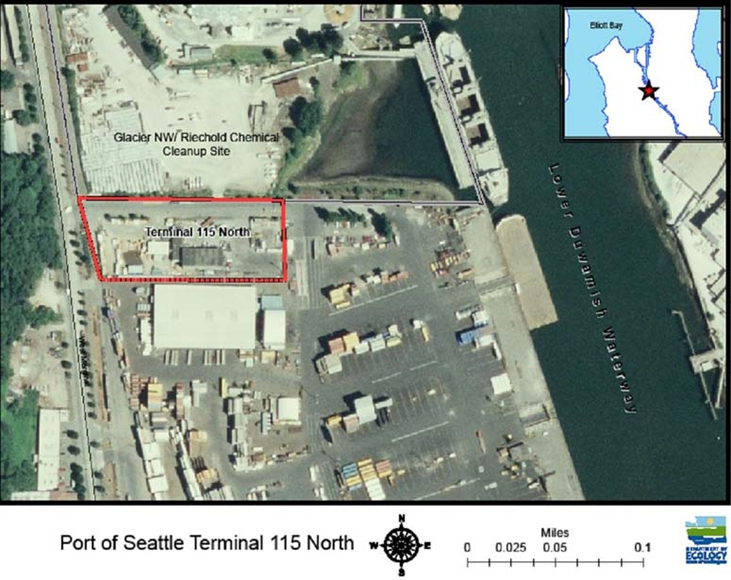
Past operations led to soil and groundwater contamination. The primary contaminants of concern are semi-volatile organic compounds, polyaromatic hydrocarbons, and polychlorinated biphenyls, hydrocarbons, and metals such as copper, lead, arsenic, and zinc.
As the current property owner, the Port is leading efforts to address contamination at the site. The Port entered an Agreed Order with Ecology in 2010. that requires the Port to complete an RI, Feasibility Study (FS), and Draft Cleanup Action Plan (DCAP).
The Port completed the RI in 2024 and began working on the FS in 2025. The FS is anticipated to be submitted to Ecology in 2026. The DCAP is expected to be completed in 2027. Remedial Design is expected to begin in 2028, and construction contracting is estimated to begin in 2030.
Brick Spangler | Senior Environmental Program Manager | [email protected]
Visit Ecology’s Terminal 115N Cleanup Site for more information.